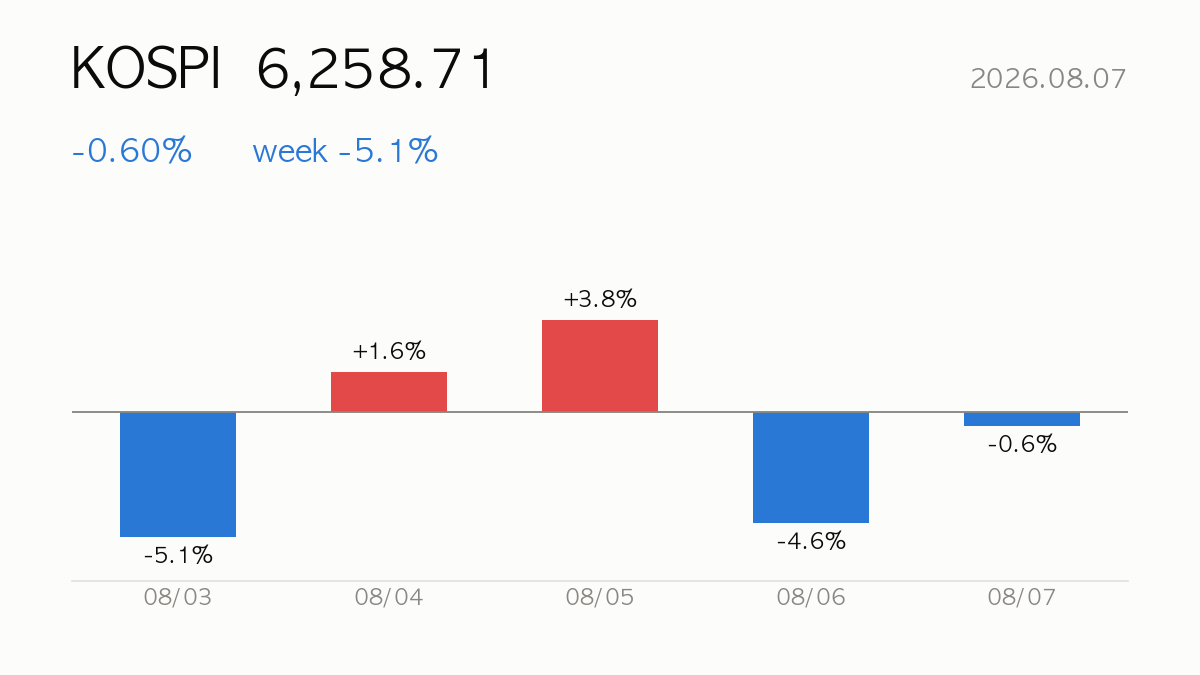
Daily Korea Market Report · as of 2026-08-07 close
The KOSPI closed at 6,258.71, down 0.60% on the day. It remains -31.3% below its recent peak. Our system’s Korea crash gate is currently blocking new entries — a high-volatility regime. Overall regime call: INFLATION.
|
KOSPI Close
6,258.71
-0.60% · -31.3% vs peak
|
Volatility (20d realized)
102.6
Panic ≥40
|
USD/KRW
1,416.2
-0.35% · 1M -5.8%
|
Regime
INFLATION
🔴 Entries blocked
|
📝 Market Wrap
■ Market Overview & Leaders
KOSPI slipped 0.60% to 6,258.71, mirroring softness across regional peers — Nikkei -0.12%, TAIEX -0.38%, and even the S&P 500 -0.18%. KOSDAQ eased 0.36% to 798.80, while the won firmed slightly to 1,416.18. Beneath the index-level red, leadership rotated sharply: energy and chemicals surged, with Hanwha Solutions (+11.5%), SK Innovation (+10.8%), and S-Oil (+10.2%) topping gainers alongside Samsung SDI and LG Chem. AI-adjacent and tech heavyweights bore the brunt — Korea Zinc (-10.4%), NAVER (-7.1%), and SK Hynix (-4.9%) all tumbled after disappointing results fueled fresh AI-stock selloff fears.
■ Flows & Breadth
Notably, breadth actually improved despite the index decline — 25 large-caps advanced versus 15 decliners, underscoring that the drop was concentrated in a handful of mega-cap tech names. This index-breadth divergence is worth flagging for foreign investors wary of Korea’s narrow AI-driven concentration. The system risk gate remains active, reflecting an ongoing high-volatility regime that traders should treat with caution.
■ Takeaway
With volatility running historically elevated and leadership rotating hard toward value/energy, single-stock exposure to AI-linked names remains prone to outsized swings ahead.📉
📊 Market Snapshot
| Index | Close | 1D | 5D | 1M | vs Peak |
|---|---|---|---|---|---|
| KOSPI | 6,258.71 | -0.60% | -5.1% | -13.6% | -31.3% |
| KOSDAQ | 798.80 | -0.36% | +11.0% | +1.8% | -34.9% |
| S&P 500 | 7,709.96 | -0.18% | +3.7% | +3.0% | -0.3% |
| USD/KRW | 1,416.2 | -0.35% | -0.3% | -5.8% | -8.9% |
| Nikkei 225 | 65,607 | -0.12% | +1.9% | -1.8% | -9.3% |
| Taiwan TAIEX | 44,226 | -0.38% | +2.6% | -3.3% | -7.4% |
💡 Korea Market 101

🏷️ Large-Cap Movers (Today)
| Gainers | Chg | Losers | Chg |
|---|---|---|---|
| 한화솔루션 | +11.5% | 고려아연 | -10.4% |
| SK이노베이션 | +10.8% | NAVER | -7.1% |
| S-Oil | +10.2% | SK하이닉스 | -4.9% |
| 삼성SDI | +7.5% | 삼성에스디에스 | -4.7% |
| LG화학 | +5.7% | 삼성생명 | -4.2% |
Large-cap breadth: 25 up · 15 down (of 40)
The index fell, but more stocks rose than fell — losses were concentrated in a few heavyweights.
💡 Korea Market 101
🔄 Sector Rotation
| Sector | 1M | 3M | Score | Type |
|---|---|---|---|---|
| 부동산/리츠 | +70.6% | +77.7% | 86.2 | — |
| 소비재 | -1.5% | -12.6% | -0.4 | Growth |
| 반도체/IT | -3.1% | -30.2% | -0.5 | Growth |
| 유틸리티 | +0.8% | -38.7% | -1.8 | Defensive |
| 필수소비재 | +6.7% | -4.7% | -2.5 | Defensive |
| 에너지 | +4.8% | -10.6% | -2.6 | Defensive |
| 금융 | +4.7% | -14.6% | -2.7 | Defensive |
| 통신/인터넷 | +2.7% | -7.8% | -3.9 | Growth |
💡 Korea Market 101
📐 Market Breadth
(40 names)
| Above 200-DMA | Above 50-DMA | Up over 1M | 52-wk highs | 52-wk lows |
|---|---|---|---|---|
| 58% | 45% | 55% | 0% | 0% |
💡 Korea Market 101
📰 Headlines (English coverage of Korea)
- Goldman says Korea’s AI-stock selloff has gone too far, doubles down on bull case — Business Insider
- South Korea’s president wanted a hot stock market. He got more than he bargained for — Financial Times
- Young South Korean investors are finding company in collective misery by sharing their losses on social media — Business Insider
- South Korea’s Stock Market Crash Is Now Officially Worse Than 1997 and 2008 — Yahoo Finance
- How A.I. Mania Turned This Stock Market Into a ‘Version of Squid Game’ — The New York Times
- Why South Korea’s Stock Index Is More Volatile Than Bitcoin — Bloomberg
- South Korea $2 trillion stock rout breaks records as SK Hynix results disappoint — Reuters
- South Korea’s ‘bipolar’ stock market: meltdowns, a record rally and what’s to come — CNBC
Headlines are credited to their publishers — click a headline to open the original article.
💡 Korea Market 101
🌐 Macro Dashboard
| Indicator | Level | 1M | Signal |
|---|---|---|---|
| US 10Y yield | 0.74 | — | — |
| Dollar Index (DXY) | 119.70 | -0.7% | — |
| Gold | 4,352 | +5.4% | — |
| WTI Crude | 82.00 | +3.5% | — |
| Bitcoin | 64,264 | +0.7% | — |
💡 Korea Market 101
🌡️ Regime & Risk Diagnosis
- Regime call: INFLATION — Inflationary — growth with rising price pressure
- Allocation guide: Tilt toward real assets and value
- Crash gate: 🔴 Blocking new entries
- 5-day index return +16.5% (threshold -8%) · 20-day realized vol 102.6 (threshold 40) — the system automatically resumes new entries once both metrics normalize.
💡 Korea Market 101
🎯 System Watchlist
Sectors in focus: 금융 7 names · 필수소비재 3 names · 반도체/IT 2 names · 화학/소재 1 names · 바이오/헬스 1 names
| Name | Mkt | Sector | Style | Score | Target | Stop | Status |
|---|---|---|---|---|---|---|---|
| 한화생명 | KR | 금융 | Swing | 100 | +20.0% | -10.0% | Watching |
| 코스맥스비티아이 | KR | 금융 | Swing | 100 | +20.0% | -10.0% | Watching |
| 동국홀딩스 | KR | 금융 | Swing | 100 | +20.0% | -10.0% | Watching |
| 오리온 | KR | 필수소비재 | Swing | 90 | +29.2% | -14.6% | Watching |
| 롯데정밀화학 | KR | 화학/소재 | Swing | 90 | +20.0% | -10.0% | Watching |
| 삼성전자 | KR | 반도체/IT | Swing | 90 | +20.0% | -10.0% | Watching |
| 현대지에프홀딩스 | KR | 금융 | Swing | 90 | +20.0% | -10.0% | Watching |
| 무학 | KR | 필수소비재 | Squeeze | 90 | +17.3% | -8.6% | Watching |
| DB손해보험 | KR | 금융 | Swing | 90 | +20.0% | -10.0% | Watching |
| 오뚜기 | KR | 필수소비재 | Swing | 80 | +20.0% | -10.0% | Watching |
| 코리안리 | KR | 금융 | Swing | 80 | +20.0% | -10.0% | Watching |
| 서울보증보험 | KR | 금융 | Swing | 80 | +20.0% | -10.0% | Watching |
💡 Korea Market 101
🩺 System Health Check
- Risk gate: 🔴 Blocking new entries
- [KR Crash Gate] 실현변동성 20일 102.6 ≥ 40 — 패닉 국면, 신규 진입 차단
- Circuit breaker: 🟢 Normal
- Entry attempts blocked by the gate today: 42
💡 Korea Market 101
🤖 System Trading Status
No positions closed today.
💡 Korea Market 101
Published 2026-08-07 15:51 KST
For information only — not investment advice or a solicitation. All investment decisions are your own responsibility.
Leave a Reply