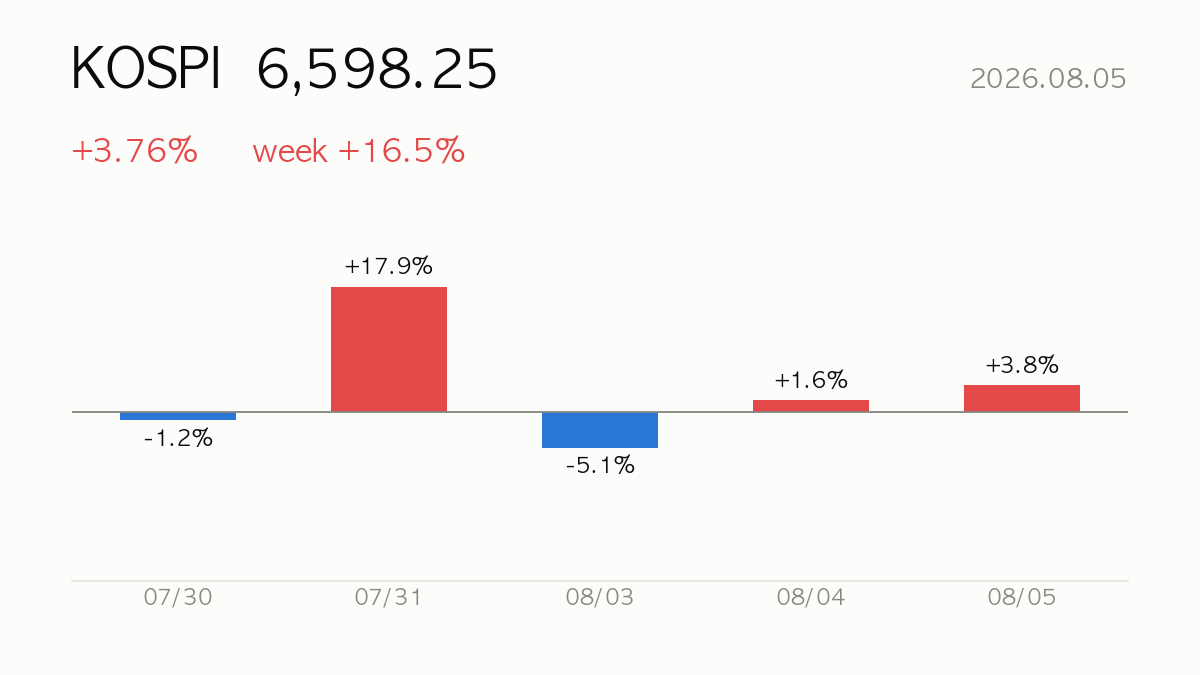
Daily Korea Market Report · as of 2026-08-05 close
The KOSPI closed at 6,598.25, up 3.76% on the day. It remains -27.6% below its recent peak. Our system’s Korea crash gate is currently blocking new entries — a high-volatility regime. Overall regime call: INFLATION.
|
KOSPI Close
6,598.25
+3.76% · -27.6% vs peak
|
Volatility (20d realized)
102.0
Panic ≥40
|
USD/KRW
1,424.0
-0.31% · 1M -6.8%
|
Regime
INFLATION
🔴 Entries blocked
|
📝 Market Wrap
■ Market Overview & Leaders
KOSPI staged a sharp rebound, surging 3.76% to 6,598.25, with KOSDAQ up 2.41% to 799.57. Regional peers joined the bounce — Nikkei 225 climbed 3.66% to 66,300.44, Taiwan TAIEX rose 2.88% to 44,611.60, while the S&P 500 gained 1.79% overnight. The won firmed modestly, USD/KRW easing 0.31% to 1,424.04. Large-cap leadership was broad-based: Samsung Electro-Mechanics (+14.4%), Hanwha Solutions (+12.5%), KCC (+9.0%), SK (+8.5%) and Hyundai E&C (+8.5%) paced gains, while S-Oil (-2.6%) and SK Innovation (-1.9%) lagged.
■ Flows & Breadth
Breadth confirmed the rally rather than diverging from it — 34 large-cap advancers versus just 5 decliners out of 40 names, a healthy participation ratio. Still, the system risk gate remains active in a high-volatility regime, a reminder that today’s snapshot follows headline-grabbing turmoil, with reports of a historic multi-trillion-dollar rout and angry retail investors vowing to stay away.
■ Takeaway
Today’s broad-based bounce offers relief, but with the risk gate still blocking flows and volatility narratives (from “uninvestable” labels to Bitcoin comparisons) dominating global coverage, sentiment remains fragile and prone to sharp reversals. 📈
📊 Market Snapshot
| Index | Close | 1D | 5D | 1M | vs Peak |
|---|---|---|---|---|---|
| KOSPI | 6,598.25 | +3.76% | +16.5% | -18.0% | -27.6% |
| KOSDAQ | 799.57 | +2.41% | +20.7% | -5.6% | -34.8% |
| S&P 500 | 7,736.52 | +1.79% | +4.1% | +2.6% | +0.0% |
| USD/KRW | 1,424.0 | -0.31% | -2.0% | -6.8% | -8.4% |
| Nikkei 225 | 66,300 | +3.66% | +7.9% | -4.9% | -8.4% |
| Taiwan TAIEX | 44,612 | +2.88% | +11.4% | -4.2% | -6.6% |
💡 Korea Market 101

🏷️ Large-Cap Movers (Today)
| Gainers | Chg | Losers | Chg |
|---|---|---|---|
| 삼성전기 | +14.4% | S-Oil | -2.6% |
| 한화솔루션 | +12.5% | SK이노베이션 | -1.9% |
| KCC | +9.0% | 코웨이 | -1.6% |
| SK | +8.5% | HMM | -0.5% |
| 현대건설 | +8.5% | LG화학 | -0.4% |
Large-cap breadth: 34 up · 5 down (of 40)
💡 Korea Market 101
🔄 Sector Rotation
| Sector | 1M | 3M | Score | Type |
|---|---|---|---|---|
| 부동산/리츠 | +52.6% | +68.3% | 72.7 | — |
| 반도체/IT | -8.0% | -28.5% | 0.1 | Growth |
| 유틸리티 | -3.2% | -36.9% | -0.0 | Defensive |
| 소비재 | -7.9% | -12.5% | -2.0 | Growth |
| 에너지 | +2.0% | -14.8% | -5.3 | Defensive |
| 통신/인터넷 | -0.1% | -9.5% | -5.7 | Growth |
| 방산/산업재 | -0.6% | -17.7% | -6.3 | — |
| 금융 | -4.4% | -17.1% | -6.8 | Defensive |
💡 Korea Market 101
📐 Market Breadth
(40 names)
| Above 200-DMA | Above 50-DMA | Up over 1M | 52-wk highs | 52-wk lows |
|---|---|---|---|---|
| 58% | 32% | 32% | 0% | 0% |
💡 Korea Market 101
📰 Headlines (English coverage of Korea)
- Global shockwaves as South Korea’s crash rattles markets — ABC News & Headlines – Australian Broadcasting Corporation
- South Korea’s Stock Market Risks ‘Uninvestable’ Label, Echoes 2015 Chinese Crash — 조선일보
- South Korea’s president wanted a hot stock market. He got more than he bargained for — Financial Times
- Crushed by Kospi rout, angry Koreans rip Lee and vow not to buy — Fortune
- How A.I. Mania Turned This Stock Market Into a ‘Version of Squid Game’ — The New York Times
- Why South Korea’s Stock Index Is More Volatile Than Bitcoin — Bloomberg.com
- South Korea $2 trillion stock rout breaks records as SK Hynix results disappoint — Reuters
- South Korea’s ‘bipolar’ stock market: meltdowns, a record rally and what’s to come — CNBC
Headlines are credited to their publishers — click a headline to open the original article.
💡 Korea Market 101
🌐 Macro Dashboard
| Indicator | Level | 1M | Signal |
|---|---|---|---|
| US 10Y yield | 0.79 | — | — |
| Dollar Index (DXY) | 119.70 | -0.7% | — |
| Gold | 4,235 | +2.2% | — |
| WTI Crude | 84.20 | +21.1% | ▼ |
| Bitcoin | 64,175 | -1.2% | — |
💡 Korea Market 101
🌡️ Regime & Risk Diagnosis
- Regime call: INFLATION — Inflationary — growth with rising price pressure
- Allocation guide: Tilt toward real assets and value
- Crash gate: 🔴 Blocking new entries
- 5-day index return -7.4% (threshold -8%) · 20-day realized vol 102.0 (threshold 40) — the system automatically resumes new entries once both metrics normalize.
💡 Korea Market 101
🎯 System Watchlist
Sectors in focus: 금융 5 names · 필수소비재 2 names · 화학/소재 1 names · 반도체/IT 1 names
| Name | Mkt | Sector | Style | Score | Target | Stop | Status |
|---|---|---|---|---|---|---|---|
| 한화생명 | KR | 금융 | Swing | 100 | +20.0% | -10.0% | Watching |
| 코스맥스비티아이 | KR | 금융 | Swing | 100 | +20.0% | -10.0% | Watching |
| 동국홀딩스 | KR | 금융 | Swing | 100 | +20.0% | -10.0% | Watching |
| 오리온 | KR | 필수소비재 | Swing | 90 | +29.2% | -14.6% | Watching |
| 롯데정밀화학 | KR | 화학/소재 | Swing | 90 | +20.0% | -10.0% | Watching |
| 삼성전자 | KR | 반도체/IT | Swing | 90 | +20.0% | -10.0% | Watching |
| 오뚜기 | KR | 필수소비재 | Swing | 80 | +20.0% | -10.0% | Watching |
| 코리안리 | KR | 금융 | Swing | 80 | +20.0% | -10.0% | Watching |
| 서울보증보험 | KR | 금융 | Swing | 80 | +20.0% | -10.0% | Watching |
💡 Korea Market 101
🩺 System Health Check
- Risk gate: 🔴 Blocking new entries
- [KR Crash Gate] 실현변동성 20일 102.0 ≥ 40 — 패닉 국면, 신규 진입 차단
- Circuit breaker: 🟢 Normal
- Entry attempts blocked by the gate today: 124
💡 Korea Market 101
🤖 System Trading Status
No positions closed today.
💡 Korea Market 101
Published 2026-08-05 15:51 KST
For information only — not investment advice or a solicitation. All investment decisions are your own responsibility.
Leave a Reply