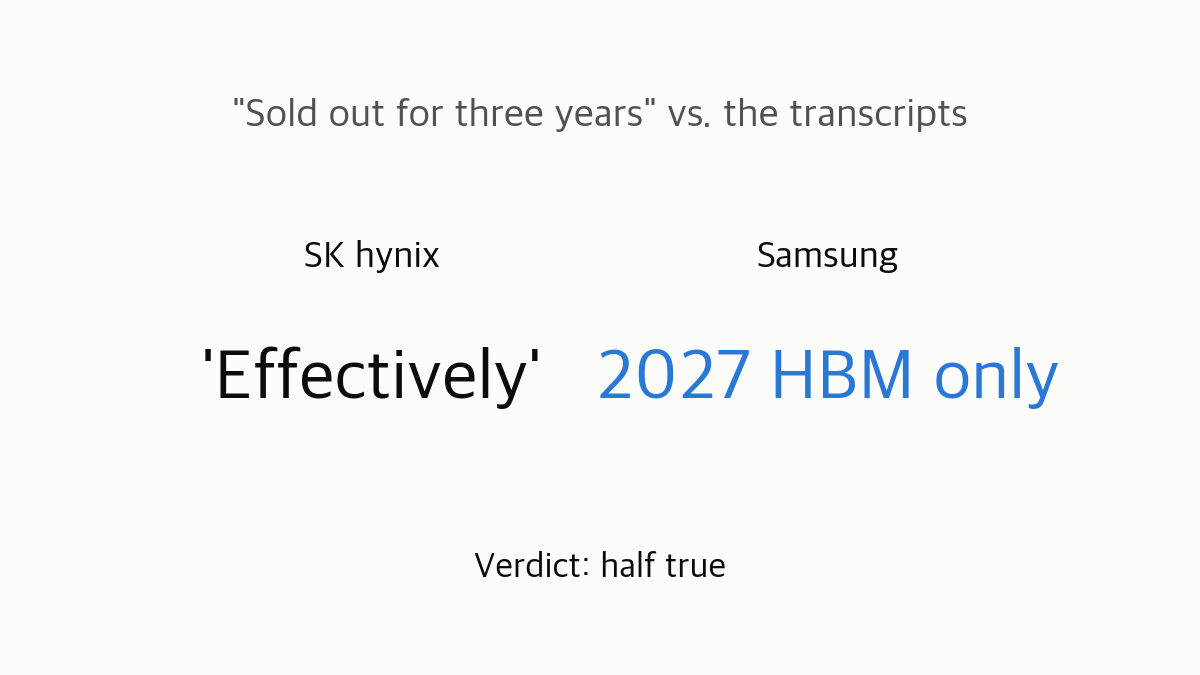
"Samsung Electronics and SK hynix have already sold all the chips they will make over the next three years." The claim spread widely in Korea after the late-October earnings season. I checked it against the transcripts of both companies' Q3 earnings calls.
The verdict: half true. Only SK hynix said "three years sold out," and even that came with the qualifier "effectively" and a specific way of counting. What Samsung Electronics said was sold out was 2027 HBM only.
| The claim | What the transcripts say | Verdict |
|---|---|---|
| SK hynix sold out for 3 years | "DRAM and HBM volumes for the next three years through 2029 are effectively all sold out." The judgment adds demand still under negotiation to volumes under signed long-term agreements | Mostly true, with a caveat |
| SK hynix has 3 years of signed contracts | Volumes secured under long-term agreements are more than 50% of total capacity for 2027 and 2028 | Exaggerated |
| Samsung sold out for 3 years | "2027 HBM supply volume is (…) already sold out." No "sold out" language for commodity DRAM or NAND | Not true |
| Samsung sold out for 2028 too | "Tight supply conditions will continue in 2028" — a forecast, with nothing about contracts | Not true |
Bar lengths illustrate scope, not exact shares. Only SK hynix’s 50% is a disclosed figure.
SK hynix: why "effectively" is there
On its October 28 earnings call, the company answered that DRAM and HBM volumes for the three years through 2029 are "effectively all sold out." The explanation given was that it combined volumes already secured under long-term supply agreements (LTAs) with demand being specifically negotiated with customers.
CFO Kim Woo-hyun separately disclosed the share locked in by contract. LTA volumes secured so far are more than 50% of total capacity for 2027 and 2028, and contracts have been signed with 14 customers, including major global cloud companies. No figure was given for the contracted share of 2029.
So the accurate version is: "A little over half of 2027–28 volume is locked in by contract, the rest is being negotiated with customers who want to buy, and the company counts the two together as effectively sold out." The company did not lie. But that is not the same as "three years of contracts signed."
Samsung Electronics: sold out means 2027 HBM
The next day, October 29, Samsung Electronics used much narrower language: "2027 HBM supply volume has been fully negotiated at target-level prices that reflect our product competitiveness and is already sold out." It also said major customers keep asking for more.
The rest:
- Commodity DRAM and NAND: No "sold out" language. Demand is said to exceed the pace of supply expansion. In fact, the company added the caveat that "some demand adjustment is expected in mobile and PC applications in 2027."
- 2028: Only a supply-demand outlook that "tight supply conditions will continue." Nothing about volumes, prices or contracts.
- Long-term agreements: Signed with 10 large customers and under negotiation with 10 more. The goal is to raise long-term contracts to 60–70% of capacity by 2030. A goal means it isn't at that level yet.
Where "three years for both" came from
SK hynix's "three years effectively sold out" (Oct 28) and Samsung's "2027 HBM sold out" (Oct 29) came one day apart. Merge them into one sentence and you get "Samsung and SK hynix sold out for three years." Along the way, SK hynix's "effectively" and "including volumes under negotiation," and Samsung's "HBM and 2027 only," fell away.
In August, DigiTimes also reported that the three memory makers had allocated all of their 2027 DRAM and HBM capacity. That was an industry report, not a company announcement, but layered on top, "sold out" hardened into something that sounded true of the whole industry.
Sold out doesn't lock in earnings
Even if every unit were locked in by contract, that would not lock in three years of earnings. There are three reasons.
1. Prices are not fixed. SK hynix's CFO explained that LTA prices are set within a range agreed with customers and reflect market conditions. The point is that prices can follow the market up, but under the same structure they also move toward the bottom of the range when the market falls. The volume is sold; the price is not settled.
2. Long-term contract booms have happened before. During the 2017–2018 server DRAM boom, Big Tech companies also rushed to sign LTAs. When inventory adjustment began in the second half of 2018, contract fulfillment slowed and the industry faced a memory price collapse in 2019 (Edaily, August 2026). This time the contracts include enforcement features such as deposits; SK hynix's CFO mentioned "substantive enforcement mechanisms such as deposits." Even so, the same article relayed the industry view that if demand turns, contracts could be renegotiated with losses partly shared. Suppliers also find it hard to fight customers to the end when future business is at stake.
3. Sold out also means supply can't grow much. Samsung said that "it will be difficult for this to lead to bit production growth in 2028." Being sold out because there isn't enough to sell does not guarantee revenue keeps growing. There is pressure on the customer side too. Memory's rapidly rising share of cloud companies' capex was covered in the previous post.
Share prices after the announcements: sold out didn't protect them
On October 28, the day SK hynix said it was sold out, the market reacted strongly.
| Oct 27 close | Oct 28 close | 1-day change | Nov 6 close | vs. Oct 28 | vs. before (Oct 27) | |
|---|---|---|---|---|---|---|
| SK hynix (KRW) | 1,341,000 | 1,487,000 | +10.89% | 1,132,000 | -23.87% | -15.59% |
| Samsung Electronics (KRW) | 222,000 | 242,000 | +9.01% | 188,700 | -22.02% | -15.00% |
| KOSPI | 5,638.34 | 6,012.44 | +6.63% | — | — | — |

Within seven trading days, both stocks were 15% below where they stood before the announcements. SK hynix peaked at KRW 1,526,000 on October 29 and fell 25.82% through November 6. In between came Intel's guidance shock, the US midterms and the memory-peak debate, one after another (background in the chip outlook post).
"Sold out" confirmed demand that was already known. What the market is fighting over is what comes next: when prices turn. The sold-out news doesn't answer that question.
This system's record: a Samsung Electronics signal the same week, stopped out
The automated trading system this site is testing (in a paper-trading validation stage) put Samsung Electronics at the top of its buy candidates on November 2. This signal, however, is currently under shadow tracking (virtual entries and exits are recorded, but no orders are placed).
- Why the signal fired: a 1-month pullback of -17.4% and an RSI of 39.8, combined with revenue growth (+130% year over year) and positive cash flow. The rule targets companies with growing earnings when they pull back. News such as "sold out" is not an input to the entry decision.
- What happened: a virtual entry at KRW 225,000 on November 4; the next day the KRW 202,500 stop broke and it exited at KRW 201,500. -10.44%, held one day.
Both the earnings numbers and the sold-out announcement pointed the right way, yet the price broke through the stop within a day. This system effectively holds the intuition "earnings are good, so buy the dip" in the form of a rule, and this time it didn't work. One trade won't change the rule, but I'll keep recording whether this pattern repeats.
What to check next
- SK hynix Q4 earnings (expected January): how far the LTA share for 2027–28 has risen from 50%, and whether it discloses the contracted share for 2029.
- Samsung's language on 2028: whether it shifts from forecast to contract, and how many of the 10 long-term deals under negotiation are completed.
- The direction of DRAM contract prices: because pricing is market-linked, this moves earnings before volume does.
Data sources. Company statements are taken from The Elec's transcripts of the SK hynix Q3 earnings call and the Samsung Electronics Q3 earnings call (both in Korean; the quotations here are my translations). SK hynix's "effectively sold out" answer came from the company side during Q&A; the transcript does not name the speaker. I also referred to reporting by SBS Biz and The Korea Economic Daily (Korean), Edaily (2026-08-04) for the 2017–2019 long-term contract episode, and TweakTown for the August industry report. Share prices were calculated directly from Yahoo Finance daily closes (unadjusted). The system record comes from its recommendation ledger (fill_type=paper, no orders placed).
How this was written. A large language model (LLM) was used for research and drafting, and statements and figures were checked against the sources above. This is the English edition of a post first published in Korean on November 7. It is not investment advice. Every trade mentioned is a shadow-tracking record from the paper-trading validation stage.
Leave a Reply