Daily Korea Market Report · as of 2026-07-24 close
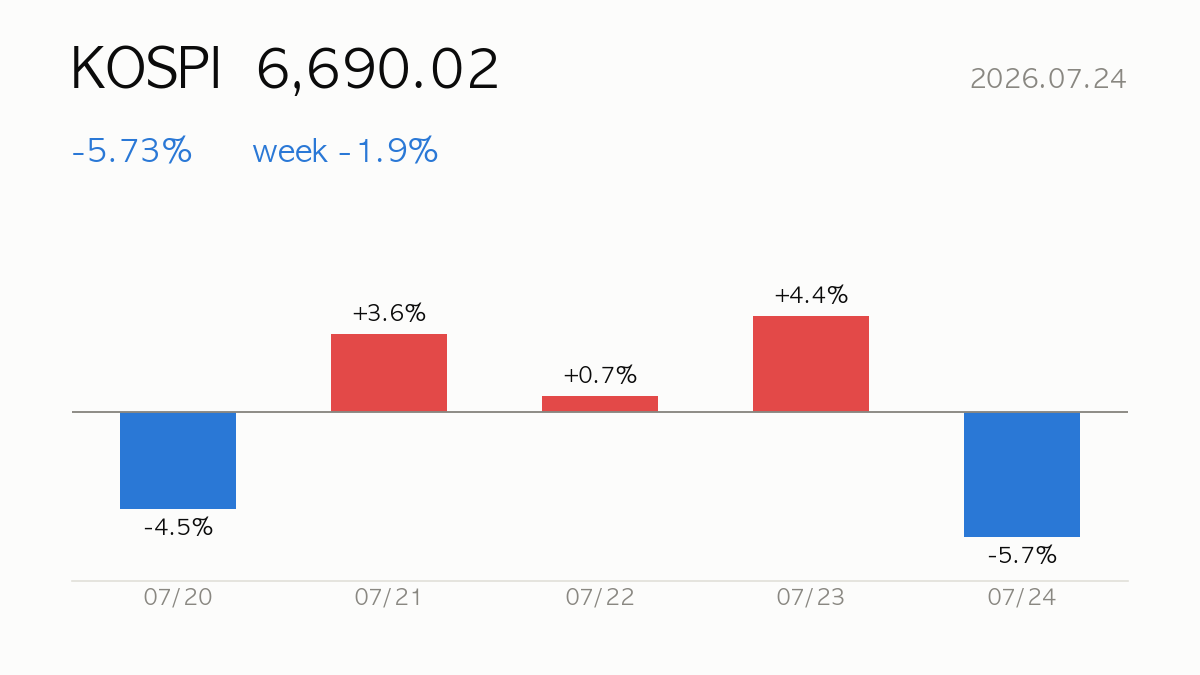
The KOSPI closed at 6,690.02, down 5.73% on the day. It remains -26.6% below its recent peak. Our system’s Korea crash gate is currently blocking new entries — a high-volatility regime. Overall regime call: RISK-OFF.
|
KOSPI Close
6,690.02
-5.73% · -26.6% vs peak
|
Volatility (20d realized)
74.0
Panic ≥40
|
USD/KRW
1,466.4
-0.63% · 1M -5.0%
|
Regime
RISK-OFF
🔴 Entries blocked
|
📝 Market Wrap
■ Market Overview & Leaders
Korean equities took a brutal hit as KOSPI plunged 5.73% to 6,690.02 and KOSDAQ tumbled 5.32% to 748.24, far outpacing regional peers — Nikkei 225 (-2.73%), Taiwan TAIEX (-2.67%) and even the S&P 500 (-1.21%). The rout was chip-led: Kia cratered -12.9%, LG Electronics -9.8%, Samsung SDI and Samsung Electro-Mechanics both -8.4%, and SK Hynix -8.3%. Defensive pockets held up, with Celltrion, HMM and Korea Zinc each up 3.1%.
■ Flows & Breadth
Large-cap breadth showed 11 advancers versus 28 decliners among 40 names — a roughly 70% decline ratio that doesn’t fully explain a near-6% index drop, underscoring how heavily semiconductor and tech heavyweights are skewing the benchmark lower. This concentration risk is exactly what makes KOSPI swing more violently than broader Asian peers. Notably, the won firmed 0.63% against the dollar even as stocks sold off, an unusual divergence.
■ Takeaway
With the system risk gate blocking trades amid high volatility, sentiment is fragile and prone to sharp reversals in either direction — Citi’s rebound call adds intrigue but caution remains warranted near-term. ⚠️
📊 Market Snapshot
| Index | Close | 1D | 5D | 1M | vs Peak |
|---|---|---|---|---|---|
| KOSPI | 6,690.02 | -5.73% | -1.9% | -21.0% | -26.6% |
| KOSDAQ | 748.24 | -5.32% | -5.5% | -17.7% | -39.0% |
| S&P 500 | 7,408.30 | -1.21% | -1.7% | +0.6% | -2.6% |
| USD/KRW | 1,466.4 | -0.63% | -0.8% | -5.0% | -5.7% |
| Nikkei 225 | 64,611 | -2.73% | -3.3% | -6.6% | -10.7% |
| Taiwan TAIEX | 43,655 | -2.67% | +2.3% | -5.2% | -8.6% |
💡 Korea Market 101

🏷️ Large-Cap Movers (Today)
| Gainers | Chg | Losers | Chg |
|---|---|---|---|
| 셀트리온 | +3.1% | 기아 | -12.9% |
| HMM | +3.1% | LG전자 | -9.8% |
| 고려아연 | +3.1% | 삼성전기 | -8.4% |
| KT | +2.7% | 삼성SDI | -8.4% |
| KT&G | +1.7% | SK하이닉스 | -8.3% |
Large-cap breadth: 11 up · 28 down (of 40)
💡 Korea Market 101
🔄 Sector Rotation
| Sector | 1M | 3M | Score | Type |
|---|---|---|---|---|
| 부동산/리츠 | +123.7% | +58.2% | 85.6 | — |
| 소비재 | -4.8% | -12.4% | 3.7 | Growth |
| 에너지 | +2.3% | -2.2% | 1.4 | Defensive |
| 필수소비재 | +6.0% | -7.4% | 1.4 | Defensive |
| 금융 | -1.7% | -10.7% | 0.7 | Defensive |
| 반도체/IT | -18.0% | -25.0% | -3.6 | Growth |
| 방산/산업재 | +3.0% | -18.9% | -6.2 | — |
| 통신/인터넷 | +1.1% | -22.6% | -8.5 | Growth |
💡 Korea Market 101
📐 Market Breadth
(37 names)
| Above 200-DMA | Above 50-DMA | Up over 1M | 52-wk highs | 52-wk lows |
|---|---|---|---|---|
| 54% | 11% | 27% | 0% | 0% |
💡 Korea Market 101
📰 Headlines (English coverage of Korea)
- Explaining South Korea’s Stock Market Boom — Korea Economic Institute of America –
- Investor appetite spreads beyond chips as Alphabet AI spending plan lifts Kospi back above 7,000 — KED Global
- Kospi to 10,000: South Korean equities poised to rebound after brutal sell-off, says Citi — CNBC
- Why South Korea’s Stock Index Is More Volatile Than Bitcoin — Bloomberg.com
- Why South Korea’s stock market is driving wild Wall Street swings — Business Insider
- KOSPI Falls Over 4% as Trading Resumes After Holiday, Deepening Bear Market — Yahoo Finance
- Inside South Korea’s world-beating bear market — Reuters
- Shares skid in Asia in sell-off of AI-related shares as Brent oil tops $100 per barrel — New Haven Register
💡 Korea Market 101
🌐 Macro Dashboard
| Indicator | Level | 1M | Signal |
|---|---|---|---|
| US 10Y yield | 0.78 | — | ▼ |
| Dollar Index (DXY) | 120.53 | -0.3% | — |
| Gold | 4,038 | +1.2% | — |
| WTI Crude | 84.40 | +17.4% | ▼ |
| Bitcoin | 65,394 | +4.6% | — |
💡 Korea Market 101
🌡️ Regime & Risk Diagnosis
- Regime call: RISK-OFF — Risk-off — investors are sheltering from risk assets (realized vol 73, USD/KRW 1,466)
- Allocation guide: Defensive stance: reduced equity exposure, higher cash allocation
- Crash gate: 🔴 Blocking new entries
- 5-day index return -0.9% (threshold -8%) · 20-day realized vol 74.0 (threshold 40) — the system automatically resumes new entries once both metrics normalize.
💡 Korea Market 101
🎯 System Watchlist
Sectors in focus: 필수소비재 1 names · 통신/인터넷 1 names · 화학/소재 1 names
| Name | Mkt | Sector | Style | Score | Target | Stop | Status |
|---|---|---|---|---|---|---|---|
| 오리온 | KR | 필수소비재 | Swing | 90 | +29.2% | -14.6% | Watching |
| LG유플러스 | KR | 통신/인터넷 | Swing | 90 | +20.0% | -10.0% | Watching |
| 롯데정밀화학 | KR | 화학/소재 | Swing | 90 | +20.0% | -10.0% | Watching |
💡 Korea Market 101
🩺 System Health Check
- Risk gate: 🔴 Blocking new entries
- [KR Crash Gate] 실현변동성 20일 74.0 ≥ 40 — 패닉 국면, 신규 진입 차단
- Circuit breaker: 🟢 Normal
- Entry attempts blocked by the gate today: 407
💡 Korea Market 101
🤖 System Trading Status
No positions closed today.
2 open positions — average unrealized P&L -3.48% (0 winning / 2 losing)

💡 Korea Market 101
Published 2026-07-24 15:51 KST
For information only — not investment advice or a solicitation. All investment decisions are your own responsibility.
Leave a Reply