Daily Korea Market Report · as of 2026-07-30 close
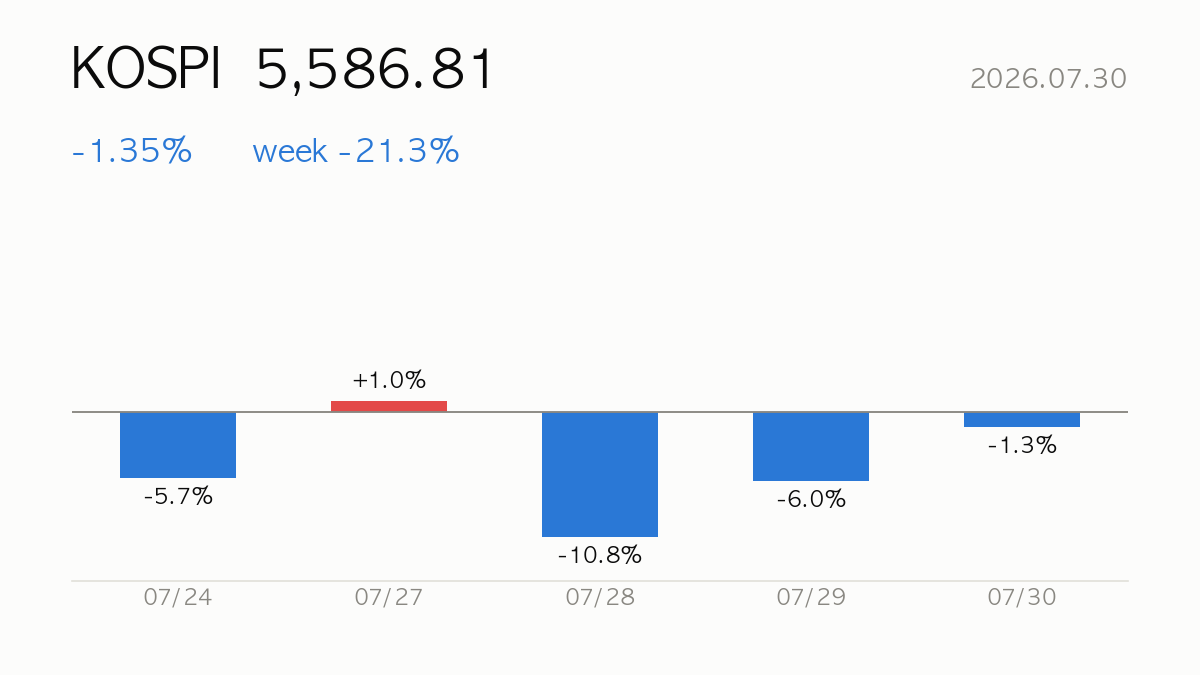
The KOSPI closed at 5,586.81, down 1.35% on the day. It remains -38.7% below its recent peak. Our system’s Korea crash gate is currently blocking new entries — a high-volatility regime. Overall regime call: INFLATION.
|
KOSPI Close
5,586.81
-1.35% · -38.7% vs peak
|
Volatility (20d realized)
79.6
Panic ≥40
|
USD/KRW
1,436.3
-1.16% · 1M -7.2%
|
Regime
INFLATION
🔴 Entries blocked
|
📝 Market Wrap
■ Market Overview & Leaders
KOSPI tumbled 1.35% to 5,586.81 and KOSDAQ dropped sharper still, down 2.70% to 644.79, as chip-sector weakness dominated. SK Hynix’s disappointing results (-5.6%) dragged sentiment, with Samsung Electro-Mechanics cratering -14.6% and SK, NAVER, and Hyundai E&C also under pressure. Yet battery and chemical names rallied hard — POSCO Future M (+6.6%), SK Innovation (+6.5%), and LG Chem (+5.6%) — alongside Celltrion (+5.6%). Regionally, Wall Street’s AI-driven slump and a weaker S&P 500 (-1.52%) set a cautious tone, while Nikkei bucked the trend (+0.71%) and Taiwan slipped modestly (-0.26%). The won firmed against the dollar (-1.16%).
■ Flows & Breadth
Notably, large-cap breadth actually favored advancers 23-17 — a clear divergence from the headline index decline, underscoring how concentrated chip-related losses are skewing the tape. Reuters and Bloomberg confirm record capital outflows (~864 trillion won) and emergency government meetings, with regulators tightening leveraged ETF curbs amid the volatility spike. The system risk gate remains blocked, reflecting an active high-volatility regime.
■ Takeaway
The KOSPI-breadth divergence suggests index-level pain is heavily semiconductor-driven rather than broad-based capitulation, a nuance foreign investors should note. With JPMorgan flagging a potential buying opportunity per Barron’s, near-term price action remains prone to volatility until chip-sector clarity emerges. 📉
📊 Market Snapshot
| Index | Close | 1D | 5D | 1M | vs Peak |
|---|---|---|---|---|---|
| KOSPI | 5,586.81 | -1.35% | -21.3% | -34.1% | -38.7% |
| KOSDAQ | 644.79 | -2.70% | -18.4% | -29.6% | -47.4% |
| S&P 500 | 7,316.15 | -1.52% | -2.4% | -1.7% | -3.9% |
| USD/KRW | 1,436.3 | -1.16% | -2.7% | -7.2% | -7.6% |
| Nikkei 225 | 61,867 | +0.71% | -6.9% | -11.7% | -14.5% |
| Taiwan TAIEX | 39,933 | -0.26% | -11.0% | -13.4% | -16.4% |
💡 Korea Market 101

🏷️ Large-Cap Movers (Today)
| Gainers | Chg | Losers | Chg |
|---|---|---|---|
| 포스코퓨처엠 | +6.6% | 삼성전기 | -14.6% |
| SK이노베이션 | +6.5% | SK하이닉스 | -5.6% |
| LG화학 | +5.6% | SK | -5.1% |
| 셀트리온 | +5.6% | 현대건설 | -3.4% |
| 포스코인터내셔널 | +5.3% | NAVER | -3.4% |
Large-cap breadth: 23 up · 17 down (of 40)
The index fell, but more stocks rose than fell — losses were concentrated in a few heavyweights.
💡 Korea Market 101
🔄 Sector Rotation
| Sector | 1M | 3M | Score | Type |
|---|---|---|---|---|
| 부동산/리츠 | +20.6% | +11.7% | 26.2 | — |
| 에너지 | +4.6% | -3.5% | 4.2 | Defensive |
| 통신/인터넷 | +4.1% | -14.7% | -4.7 | Growth |
| 금융 | -4.9% | -14.4% | -8.3 | Defensive |
| 필수소비재 | +5.1% | -12.2% | -10.0 | Defensive |
| 소비재 | -3.0% | -20.7% | -12.9 | Growth |
| 화학/소재 | -10.7% | -25.7% | -13.6 | Growth |
| 방산/산업재 | -10.3% | -26.2% | -18.3 | — |
💡 Korea Market 101
📐 Market Breadth
(40 names)
| Above 200-DMA | Above 50-DMA | Up over 1M | 52-wk highs | 52-wk lows |
|---|---|---|---|---|
| 55% | 15% | 30% | 0% | 0% |
💡 Korea Market 101
📰 Headlines (English coverage of Korea)
- South Korea $2 trillion stock rout breaks records as SK Hynix results disappoint — Reuters
- South Korea Holds Emergency Meeting as 864 Trillion Won Leaves Its Stock Market — Yahoo Finance
- South Korean Stocks Are Crashing. JP Morgan Sees a Buying Opportunity in Kospi. — Barron’s
- South Korea’s stock-market boom is collapsing spectacularly — The Economist
- Oil prices jump, while the Dow drops more than 1,100 as sinking AI stocks drag Wall Street lower — AP News
- South Korea Steps Up Leveraged ETF Curbs After Market Rout — Bloomberg.com
- US markets mixed ahead of Fed decision and oil prices jump as Middle East violence flares — ABC News – Breaking News, Latest News and Videos
- South Korea’s KOSPI posts biggest fall since early March as chipmakers slump — Reuters
💡 Korea Market 101
🌐 Macro Dashboard
| Indicator | Level | 1M | Signal |
|---|---|---|---|
| US 10Y yield | 0.71 | — | — |
| Dollar Index (DXY) | 120.71 | +0.0% | — |
| Gold | 4,093 | +1.7% | — |
| WTI Crude | 84.20 | +21.1% | ▼ |
| Bitcoin | 63,880 | +1.1% | — |
💡 Korea Market 101
🌡️ Regime & Risk Diagnosis
- Regime call: INFLATION — Inflationary — growth with rising price pressure
- Allocation guide: Tilt toward real assets and value
- Crash gate: 🔴 Blocking new entries
- 5-day index return -10.7% (threshold -8%) · 20-day realized vol 79.6 (threshold 40) — the system automatically resumes new entries once both metrics normalize.
💡 Korea Market 101
🎯 System Watchlist
Sectors in focus: 필수소비재 2 names · 금융 2 names · 화학/소재 1 names · 에너지 1 names
| Name | Mkt | Sector | Style | Score | Target | Stop | Status |
|---|---|---|---|---|---|---|---|
| 오리온 | KR | 필수소비재 | Swing | 90 | +29.2% | -14.6% | Watching |
| 롯데정밀화학 | KR | 화학/소재 | Swing | 90 | +20.0% | -10.0% | Watching |
| 오뚜기 | KR | 필수소비재 | Swing | 80 | +20.0% | -10.0% | Watching |
| 코리안리 | KR | 금융 | Swing | 80 | +20.0% | -10.0% | Watching |
| SGC에너지 | KR | 에너지 | Swing | 80 | +20.0% | -10.0% | Watching |
| GS | KR | 금융 | Swing | 80 | +20.0% | -10.0% | Watching |
💡 Korea Market 101
🩺 System Health Check
- Risk gate: 🔴 Blocking new entries
- [KR Crash Gate] KOSPI 5일 -10.7% ≤ -8.0% — 지수 쇼크, 신규 진입 차단
- [KR Crash Gate] 실현변동성 20일 79.6 ≥ 40 — 패닉 국면, 신규 진입 차단
- Circuit breaker: 🟢 Normal
- Entry attempts blocked by the gate today: 312
💡 Korea Market 101
🤖 System Trading Status
No positions closed today.
💡 Korea Market 101
Published 2026-07-30 15:51 KST
For information only — not investment advice or a solicitation. All investment decisions are your own responsibility.
Leave a Reply